
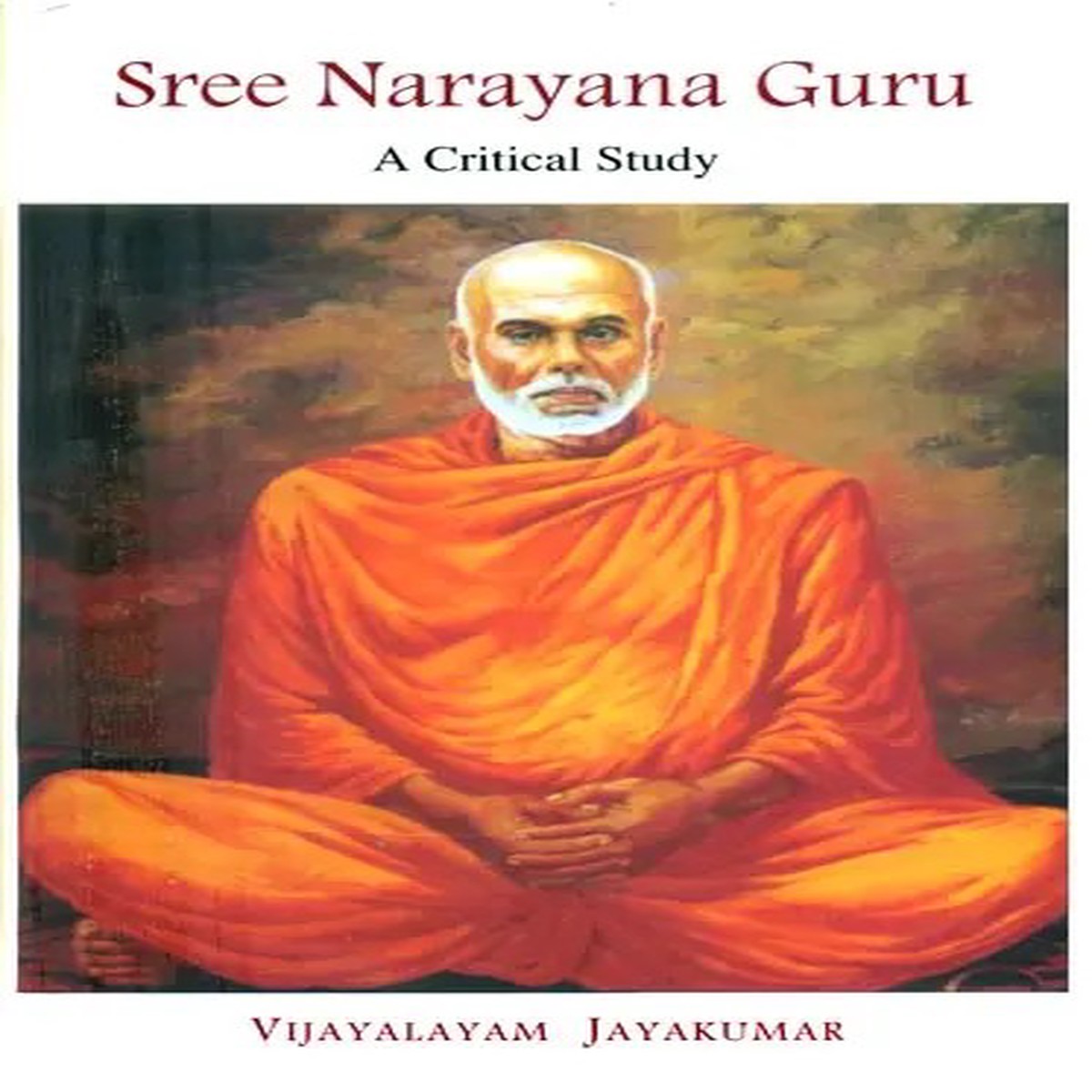
Description
Book Specification
| Item Code: | IDD203 |
| Author: | Vijayalayam Jayakumar |
| Publisher: | D. K. Printworld Pvt. Ltd. |
| Language: | English |
| Edition: | 2017 |
| ISBN: | 9788124601204 |
| Pages: | 470 |
| Cover: | Hardcover |
| Other Details | 8.8″ X 5.7″ |
| Weight | 780 gm |
Book Description
From the Jacket
It is a holistic, at once compelling account of a saint-reformer of modern Kerala: Sree Narayana Guru (1856-1928). Veritably a versatile genius: a sage, philosopher, poet and social revolutionary, all rolled into one, Gurudeva was a perfect, though largely inscrutable, human being who, like Svami Ramakrsna Paramahamsa, created new tracts of his own in the realms of Indian philosophy. And invested temporal life, in any from, with an air of spirituality about him – as is reflected, for instance, in his crusades against caste discriminations in the Kerala or in his larger concerns with peace, universal brother-hood and co-existence.
Dr. Jayakumars profile of this great guru focuses on his life, historical background, socio-cultural milieu, spirituality, philosophy, poetic genius, social reforms, humour, legacy and all else that one would possibly want to know about Sree Narayana Guru. Markedly different from the sofar-published studies on him, this book becomes the first ever to incorporate the English versions of Narayana Gurus verses: in both Malayalam and Sanskrit, together with their streamlined annotations and lucidly-written, insightful discussions. Which, in turn, also bring out Jayakumars remarkable critical acumen in highlighting the essential meaning, philosophical import and spiritual intensity of Gurudevas poetry.
A work of epical grandeur, developed from years of the authors serious, persevered research, the book reconstructs not just the life-story of a legendary saint, but also the entire scenario of his activity covering over a century of Keralas social, spiritual and literary history.
About the Author
A scholar, researcher and litterateur of wide repute, Vijayalayam Jayakumar (born: 15 November 1924) was awarded a Ph.D for his well-received dissertation on the autobiographical genre of Malayalam literature. And has had fairly long association with the Malayalam Lexican Department of Kerala University, and later with Oriental Research Institute at the Kariavattom Campus. Currently, he is Director, SNR (Sree Narayanaguru Research) Centre, Peroorkada, Thiruvananthapuram.
Dr. Jayakumars creative writing: in both prose and verse, has appeared in about forty books, including the two fictional works that are conceived on an epical scale. One of these novels, namely, Kunti-Atmadugham Ente Sugham has already been translated into English, under the title: Delight in Distress.
Prologue
Those enlightened on the mysteries of life are honoured everywhere and are considered great. Their awakening arouses those who happen to be around, triggering off at times social transformations across the country that may even gradually penetrate the world. Subtle is the way such great souls influence history.
Indiscreet man who happen to be in seats of high political authority also can create upheavals in history. Their wrong decisions taken at weak moments of disturbed emotions could end up in world wars, toppling over history headlong. Such decision-makers too find their place in history, but only to be remembered with all antipathy.
The tumbling down of normal human life across the world owing to war-mongers sometimes is abrupt. The influence of the intuitive vision of the great, on the other hand, is mostly gradual and time-consuming, often taking generations or even centuries. Its way is that of seeping slowly into the fabric of human life. The contemporaries of visionaries may mostly treat them as aberrations, unmindful even of crucifying them, charging them with the crime of corrupting the innocent youth or challenging the crown. That prophets are not honoured at home has thus become an accepted dictum. Rare indeed is the phenomenon of a visionary or prophet being honoured, with people throwing around to take his lead to bring about deliberate changes in history. Sri Narayana Guru was one. At least two million people of a country treated him as God-incarnate and as their deliverer. Yet he always remained a contemplative catalyst, absorbed always in his natural quietitude. His sublime calmness and inner clarity aroused but an adoring attitude in anyone who happened to come across him. The spontaneous expression of feelings of the poet Rabindranath Tagore, after his visiting Guru at his asrama, for example, was thus: I have been touring different parts of the world. During these travels, I have had the good fortune to come in contact with several Saints and Maharishis. But I am frankly to admit that I can never come across one who is spiritually greater than Swamy Sree Narayana Guru of Malayalam, nay a person who is on par with him in spiritual attainment.
I shall never forget his radiant face illuminated by the self-effulgent light of divine glory and his yogic eyes; whose gaze fixed at a far remote point in the distant horizon.
What made Guru so unique and mysterious was his inner clarity, his life as a materialization of that vision, and his intense, kindly wish to see the lives of people attain the same clarity and normality. Summarised in his own words, that vision in essence is:
What is understood as that person or this person,
In the world, thought of properly,
Is but one primeval Self in essence.
All the worlds and the beings in them are none other than various manifest forms of the one radiant Sun that shines in the transcendental space. One of this awareness, Guru loved every being as he did himself. Born of one Self-Reality, all were brothers for him.
The Struggle Against Casteism
Yet what he saw around him was all in discord with this vision. Children of one nature, though, one set of people suffered serfdom under another. Mankind biologically belongs to one species, yet human beings are seen to be treated as belonging to various caste layers that have no raison detre. He saw how much this senselessness had rendered human life miserable, he himself belonging to one such supposedly lover stratum. Those in the lower strata should not touch those in the upper ones some still lower should not even go near. Sweating blood, those of the lower strata produced food for all, which readily is acceptable to those of the upper layers who hoard it in their storehouses and enjoy, whereas its producers are untouchables!
People were made to believe that this caste discrimination had the sanction of religious scriptures; its sole basis being interpretations given to scriptures by the upper caste people. All such books, being in Sanskrit, were unreachable to ordinary man, not to mention that he had no chance of reading and understanding them first hand. The miseries one had to suffer in this life was the fallout of ones karmas in past lives, and the only way to make amends for them was doing meritorious deeds in the present life, doing service to Brahmins being the best of all such deeds. Such was the lesson they were taught. Reference to caturvarnya (four-fold classification of mental colouration) found in scriptures was often quoted in support of such claims, not knowing or deliberately concealing the fact that those references do relate only to psychological types, not to any social stratification. The poor believed what they were taught; the others too believed or tried to believe in what they were teaching. To expose this ignorance and enlighten people and to set things straight was taken by Guru as his lifes assignment. The real essence of Indian wisdom itself was with him for a formidable support.
Absence of knowledge, ignorance is a negative phenomenon. Eradicating it also has to be in a negative way. Any other type of means to get rid of it will help only to make it more deep-rooted. The way, therefore, to wipe out caste system, guru suggested, is not to ask, not to speak and not to think of caste. Debarring it from mind, words and deeds will end up in the gradual disappearance of caste notion from human affairs, enabling people to live as everywhere else in the world. As a positive back up for this negative way, Guru thought also of having a broad-based organization of human being in which discrimination on any count would be absent. Many were the young enthusiasta around him at that time, fully willing to act on it, most of them those who were denied any job that the education they managed to get deserved, their only disqualification being born in a law caste. Nevertheless, the organization they gave final shape to, contrary to all the expectations of Guru, was in effect of the community to which they belonged, and was meant for the spiritual and worldly uplift of that community. Guru naturally was very unhappy about it. This ended up later in his publicly declaring that he would give up that organization his mind, words and deeds.
It was the first ever communal organization not only of Kerala, but of India as a whole, its fall-out being all the communities, irrespective of caste status, getting organized one by one, each staking its own claims. Gurus honest wish for having a casteless organization of human beings thus ended up having as many organization as there are caste-communities.
Though caste-mindedness thus got more strengthened, caste-discrimination and social evils such as untouchability, unapproachability and denial of opportunities in life ameliorated much; as far as Kerala is concerned they almost disappeared. Practice of untouchability became unlawful all over India. Encouraging inter-caste marriage and inter-caste communal feeing were the sole purpose for which certain organizations shooted up. Kerala eventually became the Indian state with the least caste-discrimination in the social front, all being the net result of Narayana Gurus quiet way of creating history.
Religious Front
That caste-discrimination had a sort of approval of religion, we know, was a common notion. Religiousness and its culture had since long been seeping into the populace with temples as epicenters. In temple people felt the presence of the almighty God, the Creator, Sustainer and Dissolver of the world. Equally the children of God, all did not enjoy the equal privilege of going near Gods presence in temples. The low-castes were not to go near God and worship Him, as though God too practiced untouchability with His own children. Still the offerings made by such untouchables were not untouchable to God, for they eventually reached the hands of the upper caste. Even God thus became a tool at the hands of orthodoxy to promote it own selfish interests. If others wanted to go near Gods presence and pray, they had to make their own temple-often make-shift ones-where they were to install only certain crude forms of deities to be worshipped in equally crude and often vulgar ways. To practice purer ways of worship was taboo to them, no one knowing or thinking of who tabooed it any why. To make amends for this social evil, the way Guru chose was not a forced entry into the orthodox temples. Instead, he took the initiative to make new temples open for all with the purest and most beautiful and meaningful, the deities installed were also equally beautiful and meaningful, even educative. His installing the image of Siva at the newly conceived temple at Aruvippuram near Trivandrum marked the beginning of this new revolutionary religious movement.
Gurus new venture did not only make available a place of worship free of all caste discriminations, put it also was a silent challenge to the longstanding convention that Brahmin priests alone had the right to install a temple-deity. It was a silent proclamation that caste discrimination was not God-made but man-made, that too owing to mans ignorance. This set in motion a new religious reawakening among the downtrodden right across the whole of Kerala with demand for more new temples from different corners, and Guru too was willing to meet the new demands by consecrating more temples and installing deities like Siva, Subrahmanya and Devi. Many old temples with crude forms of worship were renovated with new deities installed and new forms of worship introduced it indeed was a turning point in the temple-culture of Kerala. Priests well-trained in their craft emerged in legions from among the low-caste. Side by side with this was gaining momentum the demand for admittance to all in the old orthodox temples; and its climax was the Vaikam Satyagraha conducted at the instance of Mahatma Gandhi, which had all the moral support of Guru. He even let the satyagraha volunteers use his own premises at the place as their camp. This movement, gradually gaining more momentum, ended up in the Crown making the famous Temple Entry Proclamation of 1936 which let open the doors of all temples to all. Neither mere political pressure nor the Crowns open-mindedness and generosity is to be considered the sole factor that prompted the authorities to make such a proclamation. The low-caste, though had no admittance to temples, were the main source of income for almost all the orthodox temples, for they formed majority of the population. A major portion of that income was being diverted to the newly-formed temples bringing the sustenance of the orthodox temples to the brink of a crisis, or the authorities were scared of such an eventuality. This too should have been one of the background aspects that led to the Proclamation.
Educational Front
Social evils like caste-discrimination are the ill-effects of ignorance, their eradication possible only through education. Guru, therefore, insisted on the importance of universalising education, himself taking the initiative in starting an English School at Varkala and a Sanskrit School at Alwaye. He knew how English had become a world language and how indispensable the modern English education was. Equally well he knew that the Indian culture was rooted in the Sanskrit language. Hence, his starting both the schools on his own. Later he even discouraged having more temples and asked people to make more schools instead. Those were the days when none thought of having schools of their own, mainly, because people couldnt believe that education was accessible to them too. Things have so changed since that such initiatives are to be curbed by government regulations. Even temples, Guru conceived, are to be served as educational and cultural centres. Their clean ambience should encourage people to gather there in evenings and discuss matters of spiritual and cultural import, to be given a push to by organizing occasional formal discussions in which invited distinguished scholars would be participating. Attached good libraries should enliven the quest for knowledge. Guru in order to transform even temple-deities into educational means, composed poetically sublime hymns either in the Malayalam, Sanskrit or Tamil language, on the occasion of installing a new temple deity, revealing how symbolically rich it was in meaning. But the followers of Guru, who got attracted by the new trend, need not be taken as having fully imbibed the high ideas and ideals Guru conceived.
For this reason, most of such new temples turned out to be a mere replica of the already existing orthodox temples but run by those of the lower strata. Instead of becoming places of worship for all, they in effect, became temples of the community concerned, yet always open for all. All the same, the new enlivening of temple culture and religious awakening among the downtrodden and the new open-mindedness and reasonableness the orthodox were brought down to in Kerala were tremendous.
Social Front
Each community then had certain of its own customs and social events observed almost with a religious fervour as symbols of their self esteem and pride, though most of them were meaningless, unreasonable, unscientific, not befitting the modern age, and, above all, pushing families down to utter poverty. Celebrating the first menstruation of a girl as a mark of recognizing her as a grown-up-girl, eight-year-old girls having to undergo a sort of formal marriage which in their later life will have no marital value, some ceremonies and social gathering at the first pregnancy of a girl, were some among them. Guru discouraged all such practices. He once even dared to walk into the scene of a group-child-marriage and stop it. He blessed the little girls giving them some sweets, and the public gathered there took the oath to discontinue the practice. Such customs and practices, various in kind and details in different communities, eventually vanished altogether. Even on occasions like marriage and funeral, spending much money on feasts and showy things were discouraged by Guru. He showed how marriages could be simplified and made less expensive with only ten participating. The spirit with which Guru showed these new lines of social life, though acceptable in principle, were not fully adaptable to all in practice, especially when social pride and showiness of the well-to-do prevailed over principles and ideals. Separate social movements bringing forth people to practice what they preach did therefore soot up, the most notable among them the Sahodara Prasthanam (Fraternity Movement) initiated by K. Ayyappan.
The new awakening the downtrodden were thus brought to was reflected in the political front as well. Kerala in due course became unparalleled in political awareness and labour movements among the Indian States.
Religious Tolerance
Christian missionaries, mostly from the West, by that time had begun to open new schools here and there. Their aim rather was using such schools as tools for converting more people to Christianity than uplifting them educationally and culturally. Those who got converted only were admitted to such schools in those days. Such forced conversion was much resented by Hindus, though caste-discrimination prevailing in Hinduism was another factor that the missionaries took advantage of. Gurus support for this anti-convertionism was also sought for, taking advantage of Mahatma Gandhis visit to him. But Gurus attitude in this matter remained perfectly neutral. One leaves ones religion as he loses belief in it, and his leaving it gives that religious the benefit of getting rid of one non-believer, whereas the other religion gets the benefit of gaining one more believer. Such was Gurus neutrality. Born though as a Hindu, in religious matters his identity was not of Hindutva. He always remained the embodiment of the spiritual enlightenment that formed the glowing core of all religions, yet the birthright of no particular religion. He could not love one religion and hate another. Of course, the temples he initiated and consecrated were of the Hindu heritage. Why did not he make or consecrate places of worship of other religions? He himself cleared this doubt: none of those religions demanded such of him; had anyone demanded he would gladly have complied. The real followers of one religion should necessarily have the knowledge of what other religions teach. He felt also the need of having some institution where all religions are taught with an open-mindedness. Creating such new trends in religions was what he aimed at when he organized a Parliament of Religions at his own ashram in Alwaye in 1924. It was the first ever inter-religious meet in India and the second in world history, the first being the one held in 1893 in Chicago. Not to argue and win, but to know and make know was the motto written large at the entrance to the venue. Such new moves initiated by Guru made Kerala the Indian State of most religious tolerance and least religious turbulence.
The last decades of Gurus life was when the National Movement in India was warming up, led by the Indian National Congress. That gaining political freedom would be meaningless unless social freedom is ensured to the oppressed classes of India did not strike the minds of the political leadership until Mahatma Gandhi visited Guru. Gandhiji, though against untouchability, was then an advocate of the caturvarnya caste system, his ideal being Ramarajya, a Vaisnavite social order in which each caste group sticks to its hereditary vocation. The topic happened to be highlighted in the discussion during his visit too. Look at the leaves of that mango tree, Gandhiji said, each leaf has its own peculiarity; so too is there difference between human beings. Chew the different leaves of a mango tree; they will taste the same, was Gurus reply. Gandhiji eventually became a spokesman of the downtrodden and he even re-christened his beloved newspaper Navajeevan as Harijan. This influence of Narayana Guru on the Indian National Movement is an aspect not much evaluated by historians.
In the History of Indian Thought
Epochal is the place of Narayana Guru in the history of Indian Philosophy, in that he represented the ancient Upanisadic non-dual vision in the age of modern science. It was in order to codify the Upanisadic speculations into a well-structured system of thought that Badarayana in the ancient days wrote the Brahma-Sutras, also known as the Vedanta-Sutras. Yet, normal to its sutra style, it was a text so condensed that, without a proper commentary it was not understandable at all. Such commentaries that arose later were many and varied, each portraying Badarayanas vision as a different one. Twenty-one such commentaries appeared. It even became a convention in India that a person, to be recognized as an adept in Vedanta, should write a new commentary of his own on the Brahma-Sutras of Badarayana. The dominant schools of Vedanta which thus sprang up were those of Sankara, Ramanuja, Madhva, Vallabha, Nimbarka, Caitanya-Mahaprabhu and the like. A modern student in search of the original philosophy of Badarayana, will find himself confused and lost among the conflicting commentaries and commentaries on commentaries, of the many schools. Guru did find a final solution: in his Atmopadesa-Satakam he resuscitated the original non-dual vision of the Upanisadic seers, presenting it in a tone familiar to the ears of the age of science.
Writing more and move commentaries, as we have just noted, was what the later Vedantins were interested in each making the essential teaching vaguer and remoter. Many were those who wrote introductory and elucidatory works on Vedanta in all its schools, but none wrote a new sutra text of Vedanta to clarify all the obscurities. Narayana Guru did do it. His Vedanta-Sutras was the result of it. He thus, though a continuator of the philosophy of Sankara, as he acknowledged once himself, was not simply repeating what Sankara said, had Sankaras philosophy is elucidated mainly in his comments on the Brahma-Sutras of Badarayana, the Upanisads and the Bhagavad Gita. Guru, on the other hand, wrote no commentary on any of the already existing basic texts. Instead, he wrote the new Vedanta-Sutras, Atmopadesa-Satakam as original as the Gita, and Darsanamala, a work of the genre of the Upanisads but more concise and precise, natural to the modern times. Guru differed from Sankara thuswise. He brought in many revisions and revaluation of the nuances of Vedanta. Also Guru did not have to, and did not, compromise with the teachings of Vedanta in practical life, while Sankara had to, for historical reasons, at least in the matter of observing caste system as he himself confessed in the Manisa Pancakam.
A hitherto unfamiliar way of presenting the philosophy of non-dualism was adopted by Guru in his Darsanamala. Many were the profound works on Vedanta that have emerged in the Sanskrit language between Sankaras time and his. Viewing the non-dual Reality from various philosophical perspectives, one following the other in a logical sequence, and leaving the seeker to intuitively perceive the Reality on his own, is the new method adopted by Guru in this work, its name itself, A Garland of Visions of the Absolute (Darsanamala) indicating it. Unparalleled though this style is in India, semblance to it could be seen in the philosophy of Henri Bergson, especially in his Introduction to Metaphysics. Nevertheles, Bergson, with his Western bend of mind, when facing the transparency of the non-dual vision, turns out to be a face-saver. No such conditioning contains Gurus spontaneous expositions of the clarity of vision. Preciseness of thinking and a clarity of mystical intuitive vision are like two sides of a coin in the philosophy of Guru.
A hitherto unfamiliar way of presenting the philosophy of non-dualism was adopted by Guru in his Darsanamala. Many were the profound works on Vedanta that have emerged in the Sanskrit language between Sankaras time and his. Viewing the non-dual Reality from various philosophical perspectives, one following the other in a logical sequence, and leaving the seeker to intuitively perceive the Reality on his own, is the new method adopted by Guru in this work, its name itself, A Garland of Visions of the Absolute (Darsanamala) indicating it. Unparalleled though this style is in India, semblance to it could be seen in the philosophy of Henri Begson, especially in his Introduction to Metaphysics. Nevertheless, Bergson, with his Western bend of mind, when facing the transparency of the non-dual vision, turns out to be a face-saver. No such conditioning contains Gurus spontaneous expositions of the clarity of vision. Preciseness of thinking and a clarity of mystical intuitive vision are like two sides of a coin in the philosophy of Guru.
In the World Thought Unique are the contributions of Guru to world thought also, especially in the field of Ethics, one of the serious topics in all philosophy. It, as a normative science, teaches what kind of activities are morally justifiable and not; it, as a descriptive science, examines human behaviour from moral point of view. Determining what is justifiable and not must needs have a criterion universally valid. Such a criterion had been lacking in all systems of thought in spite of all the ethical theorizations, the net result, all such evaluations remaining relative. Narayana Guru filled up this lacuna – his original contribution to world thought.
One Reality – the Self or the Absolute – alone exists. All multiple appearances are but its ever-changing manifestations. The essential content in the one being and another thus is one and the same, whatever the form it appears in. one who knows this basic reality sees himself in everyone else. Self-love thus gets transformed as the love for all, where loving others becomes spontaneous. Doing something beneficial to oneself and harmful to another thus becomes incongruent to the oneness of Reality. Oneness of the all-abiding Reality thus serves as the universal basis for all Ethics. An ethically sound human behaviour ensures the happiness of oneself and others. Such actions which are beneficial to one and harmful to another are unsound. Harming oneself for the sake of helping others also thus is unethical. Guru deals with this problem in Verses 21 to 25 of the Atmopadesa-Satakam.
The World Government
Getting inspired by Gurus teachings, Garry Davis, a Second World War American bomber pilot, who happened to bomb a German hospital, brought forth the ideal. One Human family, One World, One-World Government. He realized that accepting this principle alone will bring about world peace. He therefore declared, with the philosophical and moral backing of Nataraja Guru, the disciple-successor of Narayana Guru, that the world is already one; admitting it alone is needed. He even initiated the World Government of World Citizens, a movement that fully honours the famous U.N. Charter of Human Rights, a document signed by all member-nations of that world body, but none honouring it in practice. The world passport issued by the World Government at times had been a legal and moral headache to many nations including India and America. Peace lovers right across the world extended their moral support to this movement. Through the books The World is My Country and Passport to Freedom, Garry Davis let the world know all his ideas and ideals, all an application of the teachings of Narayana Guru in the world political scenario. The World Government, based in America, published the newspaper World citizens News also. Garry Davis has been traveling around the world disseminating the idea of the World Government, always on the strength of the passport he himself issued. During his first visit to India he met the then Prime Minister, Mr. Nehru and presented him with a world passport.
The world, with all the wonders achieved by modern science and technology and all the communication and transportation facilities made available, is gradually shrinking into a global village. Yet religious fundamentalism, economic interests, political ideologies and many such factors, along with their unholy alliances, together go on disintegrating the world into more and more fragmented political units. The number of member-nations of the U.N. at its inception was 51 only. Gradually increasing, the number has reached 184, the world yet remaining the same. It is mutual mistrust and fear that bring about such disintegration which in turn furthers the mistrust and fear. The only way out of this vicious predicament is nurturing the attitude of oneness, the only meaningful application of intelligence human race is gifted with. It alone will ensure even the existence of this planet of life.
The United Nations whose charter recognizes all human beings as equal and which the entire human race puts all its hopes on, has proved itself a failure. Despite all its high sounding ideals it has no right to function without admitting the sovereignty of the member-nation. It can take no decision not complying with the interests of the top five members either. No organization of sovereign states will ensure world-peace, a fact already proved in practice. Admitting the world as a political unit, which it already is geographically, is the only way to a world without wars, which in effect will be a world without armies. All the world leaders are aware of this naked truth but none knows how to work it out. Garry Davis, with the sound support of the non-dual vision of Narayana Guru and the guidance of Nataraja Guru, was shedding a new light on this ever vexing world problem. Presently Guru Nitya Chaitanya Yati is giving all the spiritual guidance he needs. The one-world dreamed by these Gurus has inevitably to become a political reality. The only question is When?
Foreword
Viewed from whatever pers


Reviews
There are no reviews yet.